
Who Should Import Coffee into Puerto Rico: The Government or the Private Sector?
Examining free markets, outdated tariff laws, and the future of Puerto Rico's coffee industry.
By Manuel Cruzado Rodríguez
Puerto Rico is an island whose economy depends heavily on imports. Coffee is no exception. Despite our centuries-old coffee-growing tradition, local agricultural production cannot meet domestic demand. Importing coffee is therefore a necessity, not merely an option.
Yet there is a question we rarely ask: Why should the government participate directly in importing and commercializing coffee when the private sector is capable of performing that role?
A Century-Old Law Governing a Modern Economy
In 1930, the United States Congress authorized Puerto Rico to impose import duties on coffee. Subsequently, Act No. 77 of 1931 established the tariff, which Congress ratified in 1934.
This legislation reflected an economic reality vastly different from today's. Its purpose was to protect local agricultural production from imported coffee that could displace Puerto Rican growers.
More than 90 years have passed. Although the legislation has been amended, its fundamental structure remains rooted in an economic model from another era.
Isn't it time to examine whether this system still serves Puerto Rico's economic interests?
When Government Becomes Both Regulator and Merchant
Through the Agricultural Enterprises Development Administration (ADEA), the Puerto Rican government participates in the purchasing and commercialization of coffee while retaining authority over important aspects of the industry's regulatory framework.
This creates a fundamental tension: the same government that establishes the rules also participates in the marketplace.
More importantly, we must examine whether government coffee imports receive different tariff treatment than imports conducted by private businesses.
If Congress authorized a tariff and subsequently ratified its application to protect local agriculture, on what legal grounds could the government import coffee without bearing the same duties imposed on private importers?
It is essential to determine whether a legal exemption exists, how it operates, and what effect it has on competition. A legally authorized exemption does not necessarily constitute tariff evasion, but it may create economic advantages that deserve scrutiny.
Agricultural Protection or Commercial Dependence?
The government has a legitimate responsibility to support and promote Puerto Rican agriculture. Our coffee farmers face high production costs, labor shortages, and significant operational challenges.
However, protecting farmers should not require restricting the commercial freedom of coffee roasters.
Why shouldn't private businesses have access to international markets under competitive conditions, negotiate directly with suppliers, and develop their operations without depending on a government-controlled supply structure?
A properly regulated free-market system could encourage greater competition, diversify sources of supply, and create new opportunities for the industry.
Agricultural protection can also be achieved through direct production incentives, productivity improvements, and programs encouraging the purchase of locally grown coffee, rather than relying exclusively on tariff barriers.
Are These Unfair Trade Practices?
When government acts simultaneously as regulator and commercial participant, legitimate concerns arise regarding equal competitive conditions.
Is it fair for private companies to compete with, or depend commercially upon, a government entity that may enjoy preferential treatment?
Determining whether unfair trade practices exist requires examining the applicable laws, potential exemptions, and measurable effects on competition. Not every government advantage is unlawful, but not every legally permitted practice represents sound economic policy.
The question is not simply whether the system is legal, but whether it is fair, competitive, and beneficial to Puerto Rico.
Maintain the Status Quo or Pursue Reform?
Puerto Rico needs productive coffee farmers, competitive roasters, and consumers who can purchase quality coffee at reasonable prices.
This discussion should not pit farmers against coffee processors. Both are essential to our economy.
What deserves evaluation is whether the government should continue playing a predominant commercial role in coffee imports or instead focus on supporting local agricultural production, enforcing market regulations, and ensuring fair competitive conditions.
After nearly a century, reviewing our tariff legislation and coffee import framework is a reasonable proposition.
Perhaps the real problem is not that Puerto Rico needs to import coffee, but that we continue relying on a system from the last century to determine who can import it and under what conditions.
Related post
09
Oct

16
Feb
RECENT POSTS
09.October.2026
Who Should Import Coffee into Puerto Rico: The Government or the Private Sector?
0 Comments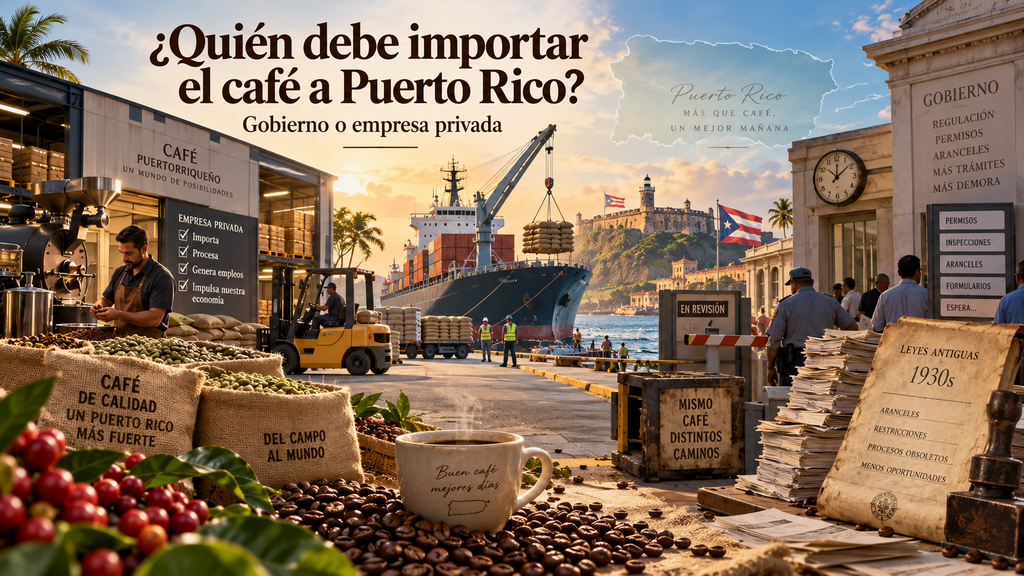
09.October.2026
¿Quién debe importar el café a Puerto Rico: el Gobierno o la empresa privada?
0 Comments